When Sam Dannenberg moved from Alaska to Christchurch at age 16, he had no idea that cochlear implants would transform not just his hearing, but his entire career path.
Sam began experiencing progressive hearing difference as a child in the United States and received hearing aids by age 12. However, his hearing continued to steadily decline.
By the time his family relocated to New Zealand, where parents Dave and Clare took up academic positions at Lincoln University and the University of Canterbury, Sam’s hearing loss had become severe.
“When we went to an audiologist here, she was like, ‘It’s probably getting to the time where you should start meeting with the Southern Cochlear Implant Programme (SCIP) people, because your hearing is just going to continue to deteriorate,’” Sam recalls.
Supported by his family, including older siblings Bella and Holt, Sam coped through school life by lip reading and remembers needing to sleep after school every day due to the physical effort it took to listen. Nonetheless, he was an excellent student.
At 18, Sam underwent cochlear implant surgery through SCIP. The switch-on moment was particularly memorable – his parents became very emotional, while Sam himself was overwhelmed by the intensity of the higher level of sound the surgery enabled.
He didn’t initially comprehend how intense the constant sound could be. “For me, everything was so loud!”
Sam treasures the quieter times that followed, like walks and conversations with his mum.
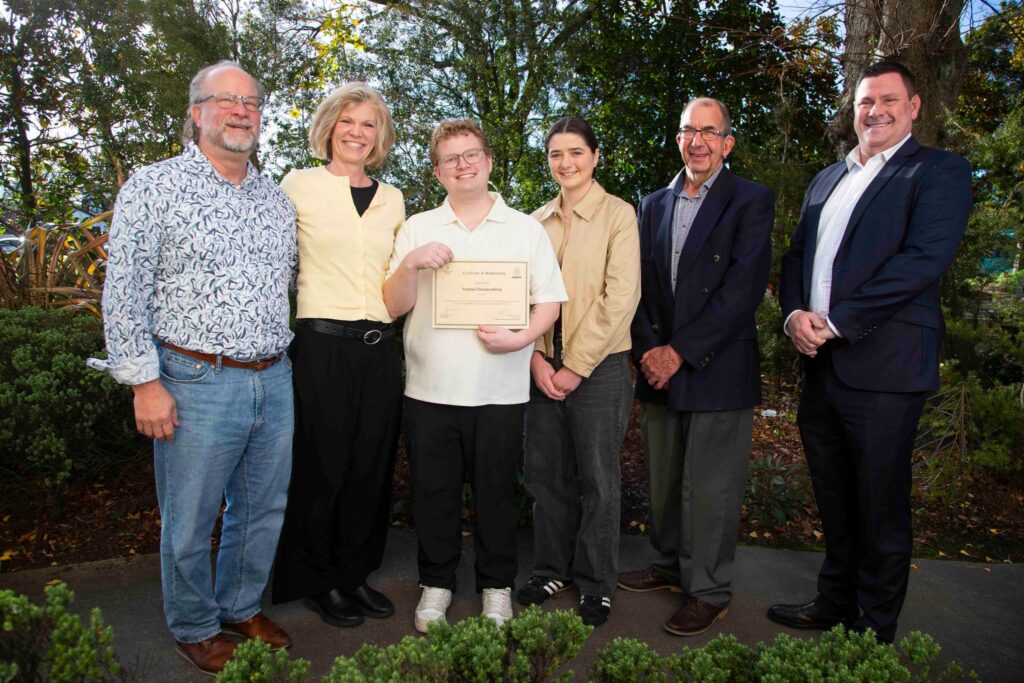
Pictured: L – R, Sam’s parents Dave & Clare, Sam, Sam’s partner Sophie, David Kent (Southern Hearing Charitable Trust Board Chair) and Jonathan Davidson (Forsyth Barr).
“It was nice to hear things again. Hearing lawnmowers and birds – we’d go on walks and hear different sounds and my mum would tell me what they are. That’s a sweet memory.”
What Sam didn’t initially realise was how profoundly the implants would change his future.
While studying law at the University of Otago alongside classics and history prior to the implants, he harboured a long-held interest in ambulance work – but believed it was impossible.
“There are medical standards, and you have to have good hearing in at least one ear, which I did not have,” Sam explains.
The cochlear technology changed everything. He could now meet the essential requirements for paramedicine and pursue his medical calling.
He enrolled in a Bachelor of Health Science in Paramedicine at Auckland University of Technology in 2023.
Sam won the 2025 Southern Hearing Charitable Trust Scholarship, sponsored by Forsyth Barr. The prize supported him through his final year of study in Auckland, helping cover living costs in one of Aotearoa New Zealand’s most expensive cities.
“Getting an implant changed things because then I could do paramedicine,” he says. “It’s opened a lot of doors for me and allowed me to integrate into my profession very well.”
Now 21, Sam has completed his degree and landed a demanding full-time position with Hato Hone St John in Auckland as an Emergency Medical Technician – the first step on the graduate paramedic pathway.
Sam’s ambitions don’t stop at paramedicine. He’s applied to study medicine at the University of Auckland, with results due in mid-December – coincidentally, the same week as his graduation.
“I think paramedics make great doctors,” he says.
“I’m interested in primary health care and working in family medicine. I just like talking to people and knowing all their business – that’s why I think I’m good at this job.”
When it comes to labels, Sam is unequivocal.
“I would not describe myself as deaf or part of the deaf world. I never use a cochlear implant to define myself – they’re just a tool and the means to express myself.”
Beyond the practical benefits, Sam appreciates the control that a cochlear implant provides. When he needs a break from noise, he likes to take off his processor and control the volume.
Reflecting on his journey, Sam is certain about one thing: “It was the right decision to get cochlear implants. I was very skeptical at first, but it’s allowed me to do what I want to do.”
The Southern Hearing Charitable Trust Scholarship is proudly sponsored by Forsyth Barr.