When Mark Adams walks into his art gallery at his West Eyreton property in North Canterbury, there’s a light in his eyes that was missing only months ago.
The 62-year-old artist, teacher and horticulturist had lost more than his hearing – he’d lost his ability to share his teaching gifts with others.
“I couldn’t do it anymore,” Mark reflects, surrounded by vibrant paintings of New Zealand landscapes.
“Teaching art was my mission in life. My key phrase has always been ‘everyone can draw,’ and I’ve proven it for years. But when I couldn’t hear people, I couldn’t teach them.”
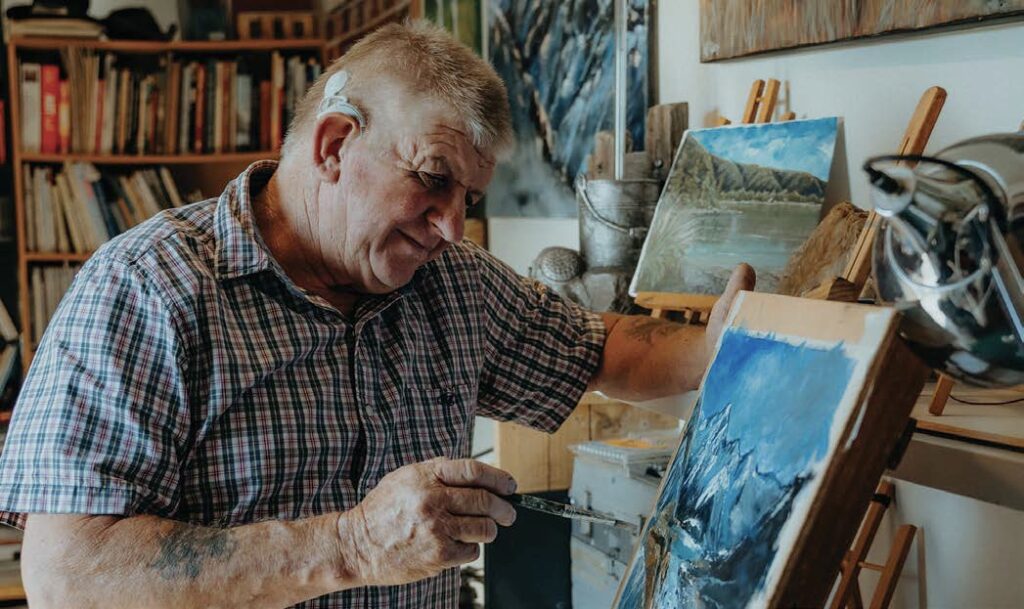
He had also worked in horticulture for many years and enjoyed sharing his green-fingered skills, training others to enjoy gardening as much as he does.
Mark’s hearing difference began in his 50s when industrial deafness from his work in a foundry as a younger man finally caught up with him.
ACC-provided hearing aids worked well for years, until his left ear went completely deaf. He was then provided with a crossover system.
But by his early 60s, his right ear began deteriorating too. Six months ago, everything changed.
“I couldn’t hear people’s voices anymore; couldn’t distinguish what they were saying,” Mark explains.
When his audiologist performed a speech test, the results were devastating. He had lost his speech recognition.
For someone who had shared his knowledge of horticulture, taught art classes for decades, sold his work throughout New Zealand, and even appeared on a television lifestyle programme demonstrating painting techniques, the silence was isolating.
Mark withdrew from family gatherings with his three children and four grandchildren in despair, unable to feel he could truly participate.
“The conversations I could have were always the same – explaining my deafness. There was never any deep conversation.”
He relied on live transcripts on his phone, but with lifelong reading difficulties due to Marfan Syndrome, keeping up was exhausting.
Earlier this year, Mark lost his job and was warned his vision problems could lead to blindness. His motivation to create art vanished, replaced by depression.
Gardening became therapeutic. Mark and his wife Gayle had moved to their lifestyle block 30 years ago and transformed it into an astounding garden paradise.
He knew from years of teaching that creativity helps with mental wellbeing, so he kept drawing out of discipline, even when the feeling of joy was gone.
Then came hope. The Southern Cochlear Implant Programme moved quickly.
Within weeks of his first appointment, he was offered surgery.
“I was blown away,” Mark says. “My wife Gayle said I looked different when we left that meeting – like walking on air.”
Ten weeks post-surgery, the transformation is remarkable.
At his cochlear device switch-on, sounds were robotic. Car tyres on the road sounded like running water.
But by the next speech processor mapping session, his audiologist was astonished. “She said what I’d learned normally takes people 12 months,” Mark shares proudly.
His secret? Understanding that rehabilitation is like physiotherapy – you have to do the work.
Mark, who has also eventually regained his vision after losing his eye lenses to Marfan Syndrome, knew persistence pays off. He researched and committed to the process.
“I can feel my brain working like a muscle, thinking and trying to understand and process what I am hearing,” he says.
Now, his world has expanded to include sound.
“My relationship with Gayle is growing again because we can actually talk and have conversations,” he says.
“The grandkids are getting used to it. When I first got it, I told them I’m bionic!”
His five-year-old grandson Theo, who lives next door with Mark’s daughter Eden, no longer has to shout or repeat himself. They draw together, fostering creativity without boundaries.
Mark’s confidence is returning, and he’s reorganising his gallery, preparing to teach again and sell his art.
“I want to contribute to society in the same way I have before, to leave a legacy, especially with the arts and creativity,” Mark explains.
For someone who has navigated blindness, diabetes, and now deafness, Mark’s optimism is infectious.
His religious faith also underpins his positivity.
“Now I see my art not just as images on paper or paint on canvas, but as testimony. It is a way to show others what perseverance, hope and love looks like.
“My desire is to offer it back so that people might find encouragement, healing or just a spark of wonder,” he says.
Looking at his paintings now, Mark sees not just New Zealand’s landscapes but his own journey – one of challenges overcome through creativity, faith and the remarkable technology that gave him back his hearing and his voice.