
For Ross, receiving a cochlear implant in his eighties has brought some unexpected discoveries. There are the birds singing in the garden, the wind moving through the valley and the river babbling nearby. But perhaps the most remarkable change has been rediscovering the joy of conversation, making new friends and reconnecting with his wife, Hilary.
Before his cochlear implant, Ross found that profound deafness could make everyday interactions difficult in ways other people didn’t always understand.
Unable to hear himself properly, Ross would speak loudly, leaving others thinking he was shouting at them. If someone called out to him from behind, he might not respond, giving the impression he was ignoring them.
“You get a reputation being sort of arrogant and standoffish, and you didn’t know that until you smile but people walk away.”
Over time, these experiences made spontaneous conversations and social situations increasingly difficult.
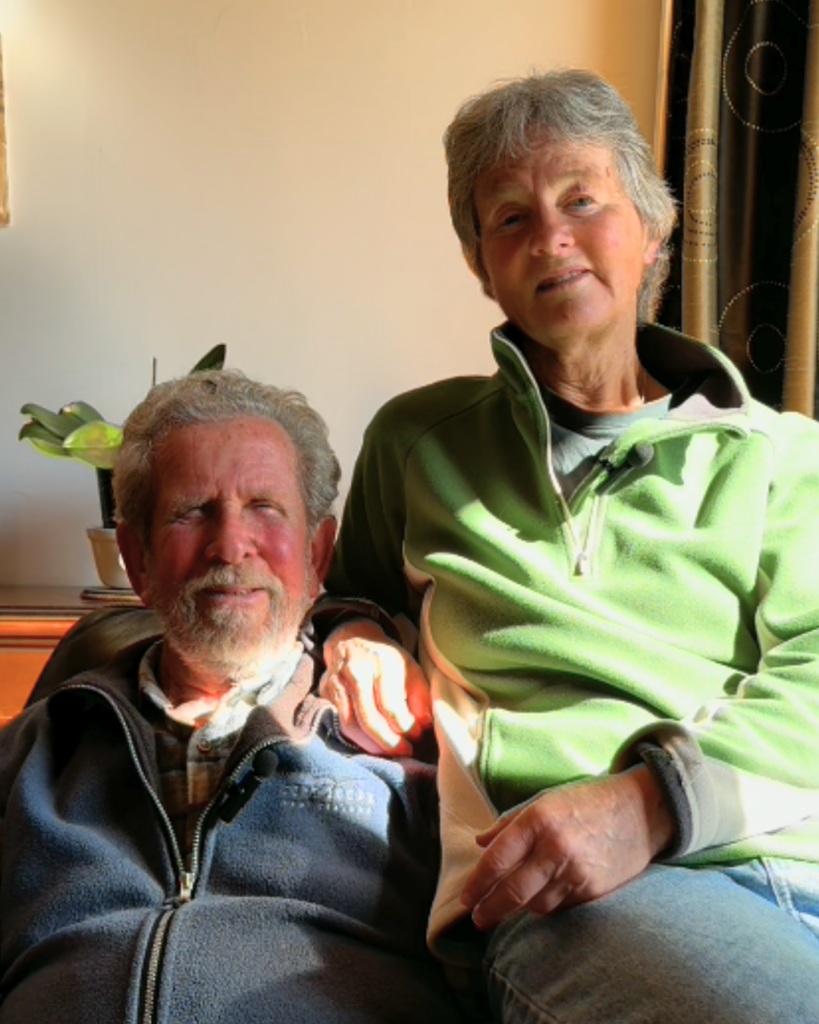
Ross and his wife Hilary
An unexpected opportunity
Ross hadn’t planned to receive a cochlear implant. He didn’t believe he was the right candidate, thinking the opportunity should go to someone younger.
“I didn’t think that I deserved it,” he explains. “I’m an old man getting ready to drop out the door, you know.”
He also assumed that getting onto the waiting list would mean years of waiting. His wife, Hilary, and his audiologist encouraged him to put his name forward.
“I said, ‘Yeah, I’m surrounded on two sides. Put my name on the list.’ But I didn’t think we’d come to anything. I was wrong. And I’m so glad I was wrong.”
When Ross’s cochlear implant was switched on, the experience was overwhelming.
“I wept. I didn’t think I would ever hear again.”
After years of relying on hearing aids, which provided limited and often unclear sound, he suddenly experienced something entirely different.
“It was a shock. But it also was like I had been promised something and it was given. And I also knew it was like jumping off a high spot and you were committed. There was no going back.
“It was the most terrifying and wonderful moment of my life. And really when you reach my age, you don’t expect those experiences anymore. And all I can say is thank you.”
The priceless value of connection
The biggest change, however, has been the ability to participate in conversations and make new friends.
“When I was deaf, I actually could handle conversations in my fashion. I could go into the conversation, we determine what we were going to say and know what topic was and move through it. But I couldn’t handle random events mainly because unless I knew what a person was going to say, I wouldn’t hear what they said.”
His solution was often to keep interactions brief and move on rather than risk misunderstandings.
“Encounters with people would be sort of, ‘G’day mate. How you going?’ Move on. Don’t stop. Don’t talk. Don’t get involved. Because if you do, the possibility of offense is infinite.”
Now, those encounters have become opportunities.
“But now, now they come towards me and we have a conversation. We talk,” he says. “It’s wonderful. It adds richness.”
For Ross, this has opened the door to something he thought he had lost: the chance to make new friends.
“The ability to make friends and enjoy friends depends so much upon being able to talk to them, to be able to share ideas.
“Generally, we have hundreds of acquaintances. And believe me, when you’re profoundly deaf about all you do have are acquaintances, people say G’day and move on. But someone you can talk to, someone who knows you, someone who still wants to know you even though they do know you, that’s precious.
“I have gained several friends in the last year, more than I’ve gained in the last 20 years.
“How do you put a price on that? This is true wealth. Wealth isn’t actually measured in terms of stacks of money. It’s measured in terms of just simply peace, happiness, fulfilment, a sense of who you are. And this is priceless.”
The difference has been just as significant for Hilary. She says the couple had barely been able to have a conversation for 25 years and had gradually stopped doing many activities together. Ross often avoided social outings because he couldn’t hear, and they had developed their own ways of communicating at home.
“Now we can talk. And that’s amazing,” Hilary says.
They have returned to working on projects together, and Ross has regained his independence. Seeing him make new friends has been another source of joy.
“It’s great that he’s making new friends,” she says. “And life is so much easier.”
A message for others considering an implant
Ross’s advice to anyone considering a cochlear implant is simple.
“Don’t delay. Try it. Because if you’re still able to wonder whether you should, you probably can. And if you have feelings that in fact you’re not worthy, that’s not true.”
Ross is a talented landscape painter. He works in oil on canvas and panel and has work in many private collections around the world. These three works are from a recent exhibition at the Nelson Suter Art Gallery.

L-R: Waikawa Bay, Croisilles Harbour and Lake Ruataniwha, MacKenzie Country

Tahunanui Beach, towards Nelson Harbour